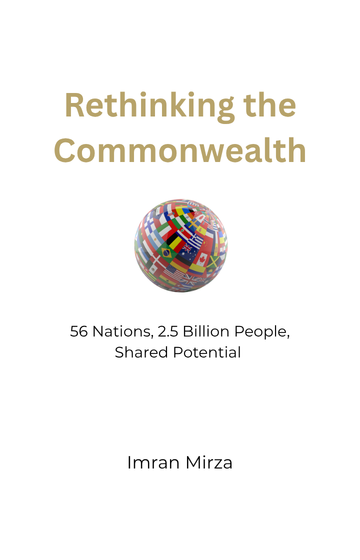
About the Book.
The Commonwealth is often described as a relic of empire. In reality, it is something far more complex, and far less understood.
Spanning 56 nations across six continents and representing more than 2.5 billion people, the Commonwealth exists not as a centralized authority, but as a distributed system shaped by shared language, common law, institutional continuity, and historical alignment. It inherited coherence from its past, yet it has never been fully organized into a deliberate system of the future.
This book examines the Commonwealth not as a political symbol, but as a structural network.
It explores how a fragmented collection of nations, bound loosely by history, may in fact represent one of the most underutilized global frameworks of the modern era. Beneath its ceremonial surface lies a dense architecture of legal compatibility, economic familiarity, educational mobility, and cultural continuity that quietly connects some of the world’s most dynamic and diverse regions.
Rather than revisiting the past through a purely historical or moral lens, this work focuses on what has been built, what remains functional, and what has yet to be realized.
It analyzes the internal mechanics of the Commonwealth across multiple dimensions, including governance structures, economic flows, institutional overlaps, demographic advantages, and systemic inefficiencies. It brings forward concepts such as shared markets, integrated talent mobility, financial interoperability, and coordinated development frameworks, not as abstract ideals, but as latent capabilities already embedded within the system.
At the same time, the book does not ignore the tensions that define the Commonwealth today. Questions of sovereignty, identity, inequality, reparations, and political divergence continue to shape its trajectory. These are not treated as obstacles alone, but as structural realities that must be understood before any meaningful evolution can occur.
What emerges is a different perspective.
The Commonwealth is not simply a legacy of what once was. It is a network that has not yet decided what it wants to become.
This book invites the reader to see it not as history, but as infrastructure. Not as symbolism, but as potential. Not as a closed chapter, but as an unfinished system waiting to be designed.
About the Author.
Imran Mirza is a strategic consultant, advisor, and systems thinker whose work focuses on the intersection of governance, infrastructure, and organizational performance. He is the founder of Golden Ratio International Business Corp and Golden Ratio Estimating, and is the publisher behind Golden Ratio Books.
Over a professional career spanning more than three decades, including over seventeen years in consulting, he has supported major energy, infrastructure, and industrial programs across multiple regions, with cumulative exposure exceeding US $90 billion. His work has involved advising organizations on cost engineering, project controls, resource strategy, and operational structuring within complex capital environments.
In parallel with his consulting practice, Imran has developed proprietary systems and automation tools for estimation, project workflows, and data integration, reflecting a broader interest in how structured systems can improve both efficiency and decision-making.
His academic and intellectual interests span engineering, technology, commerce, history, philosophy, and comparative religion. This multidisciplinary foundation informs his approach to analyzing large-scale systems, institutions, and patterns of coordination across nations.
Based in Calgary, he continues to work across advisory, writing, and systems development. His work explores how inherited structures, when properly aligned, can evolve into coherent and functional systems.